
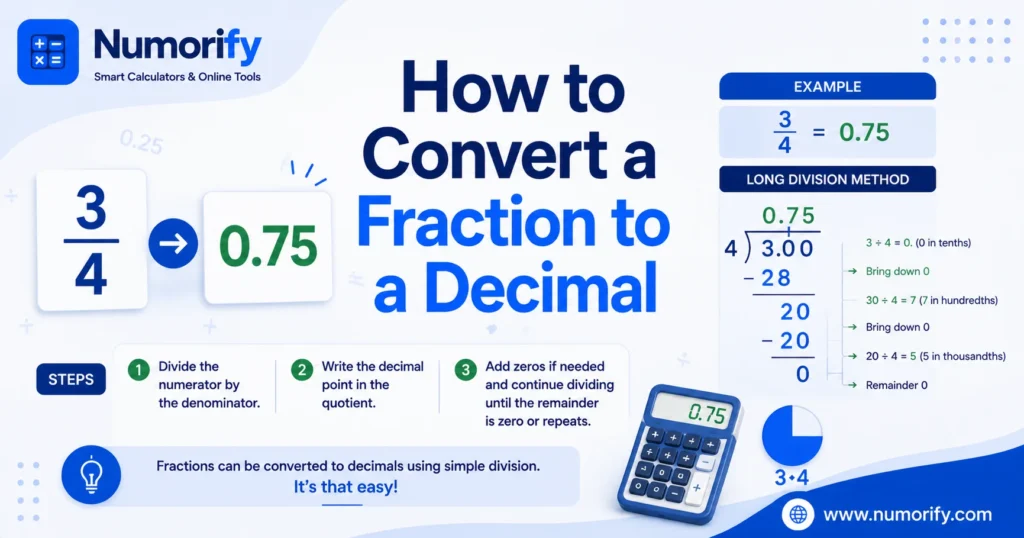
Learn how to convert a fraction to a decimal in 3 simple steps! Features easy methods, clear examples, and quick conversion shortcuts.
Quick Answer
To convert a fraction to a decimal, divide the numerator by the denominator. In a fraction such as 3/4, 3 is the numerator and 4 is the denominator.
Decimal = Numerator ÷ Denominator
For example, 3/4 becomes 3 ÷ 4 = 0.75.
What Is a Fraction?
A fraction represents a part of a whole. It is written using two numbers separated by a fraction bar. The top number is the numerator and the bottom number is the denominator.
Fraction = Numerator ÷ Denominator
For example, in 5/8, the numerator is 5 and the denominator is 8. When converting the fraction to a decimal, divide 5 by 8.
How to Convert a Fraction to a Decimal
The most direct method is to divide the numerator by the denominator.
- Identify the numerator.
- Identify the denominator.
- Divide the numerator by the denominator.
- Write the result as a decimal.
This method works for proper fractions, improper fractions and many mixed numbers after the mixed number has been converted into an improper fraction.
Examples of Converting Fractions to Decimals
Example 1: 1/2
Divide the numerator by the denominator:
1 ÷ 2 = 0.5
Therefore, 1/2 = 0.5.
Example 2: 3/4
Divide 3 by 4:
3 ÷ 4 = 0.75
Therefore, 3/4 = 0.75.
Example 3: 7/8
Divide 7 by 8:
7 ÷ 8 = 0.875
Therefore, 7/8 = 0.875.
Converting an Improper Fraction to a Decimal
An improper fraction has a numerator that is greater than or equal to its denominator. The same division method can be used.
Example: 7/4
7 ÷ 4 = 1.75
So, 7/4 = 1.75. The decimal can be greater than 1 because the fraction itself is greater than 1.
Converting a Mixed Number to a Decimal
A mixed number contains a whole number and a fraction, such as 2 1/4. You can convert the fractional part to a decimal and then add it to the whole number.
1/4 = 0.25
2 + 0.25 = 2.25
Therefore, 2 1/4 = 2.25.
Fractions That Produce Repeating Decimals
Some fractions do not produce a terminating decimal. Instead, the digits continue repeating. For example:
1 ÷ 3 = 0.333…
The repeating 3 indicates that the decimal continues indefinitely. Such a result is commonly written as 0.333… or with a repeating-decimal notation.
Terminating vs Repeating Decimals
| Fraction | Decimal | Type |
|---|---|---|
| 1/2 | 0.5 | Terminating |
| 3/4 | 0.75 | Terminating |
| 7/8 | 0.875 | Terminating |
| 1/3 | 0.333… | Repeating |
| 2/9 | 0.222… | Repeating |
Converting Fractions to Decimals Without Long Division
Some fractions can be converted quickly by changing the denominator to 10, 100, 1,000 or another power of 10.
Example: 3/5
Multiply the numerator and denominator by 2:
3/5 = 6/10 = 0.6
This method is especially useful when the denominator can easily be changed to a power of 10.
Fraction to Decimal Conversion Table
| Fraction | Decimal |
|---|---|
| 1/2 | 0.5 |
| 1/4 | 0.25 |
| 3/4 | 0.75 |
| 1/5 | 0.2 |
| 2/5 | 0.4 |
| 3/5 | 0.6 |
| 4/5 | 0.8 |
| 1/8 | 0.125 |
| 3/8 | 0.375 |
| 7/8 | 0.875 |
For related percentage calculations, see How to Calculate Percentage. If you want to calculate an average from several decimal values, you can also read How to Calculate an Average.
Authoritative Reference
For a reference on fractions, decimals, and related mathematical terminology, see the NIST reference on SI units.
Frequently Asked Questions
Divide the numerator by the denominator. For example, 3/4 becomes 3 ÷ 4 = 0.75.
Divide 1 by 2. The result is 0.5, so 1/2 = 0.5.
Yes. Dividing the numerator by the denominator produces a decimal representation. Some decimals terminate, while others repeat indefinitely.
1/3 = 0.333…, which is a repeating decimal because the digit 3 continues indefinitely.
Convert the fractional part to a decimal and add it to the whole number. For example, 2 1/4 = 2 + 0.25 = 2.25.