Quick Answer
Loan interest is the cost charged by a lender for borrowing money. The amount of interest depends on factors such as the principal, interest rate, tenure and the method used to calculate interest.
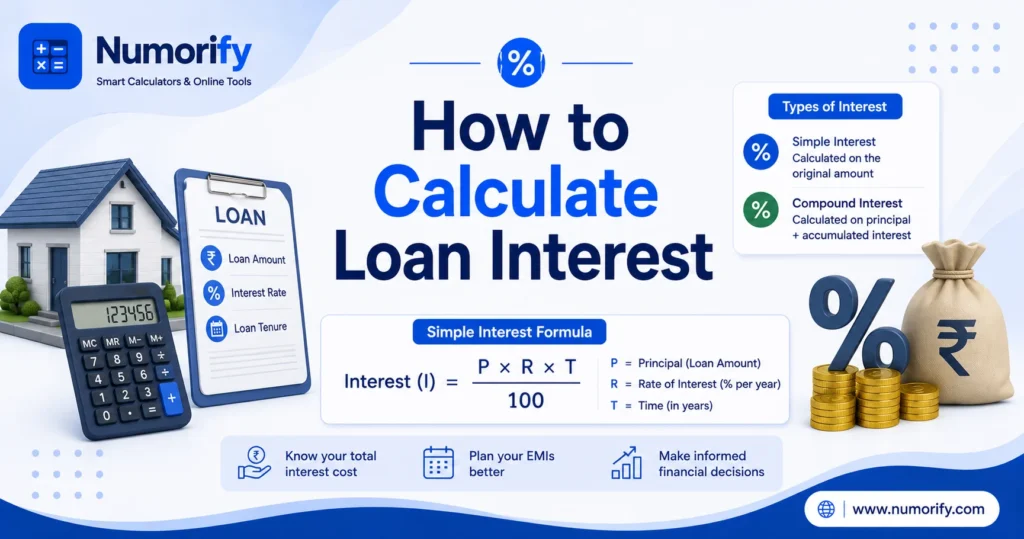
Simple Interest = Principal × Rate × Time
For loans with reducing-balance repayment, interest is generally calculated on the outstanding principal, so the interest portion can decrease as the loan is repaid.
What Is Loan Interest?
Loan interest is the amount a borrower pays to a lender in addition to repaying the principal amount borrowed. It is one of the main components of the total cost of a loan.
The interest charged on a loan can depend on the amount borrowed, the annual interest rate, the repayment period and whether the lender uses a simple, flat-rate or reducing-balance method.
Loan Interest Formula
For a simple-interest calculation, the basic formula is:
Interest = P × R × T
P = Principal, R = Annual interest rate as a decimal, T = Time in years
If the annual rate is given as a percentage, convert it to a decimal before using the formula. For example, 10% becomes 0.10.
How Principal, Rate and Tenure Affect Interest
| Factor | Effect on borrowing cost |
|---|---|
| Principal | A larger amount borrowed generally means more interest in absolute terms. |
| Interest rate | A higher rate generally increases the interest charged. |
| Tenure | A longer repayment period can increase total interest, even though the periodic payment may be lower. |
Example: Calculating Simple Loan Interest
Suppose you borrow ₹1,00,000 at an annual interest rate of 10% for 2 years under a simple-interest calculation.
Principal (P): ₹1,00,000
Rate (R): 10% = 0.10
Time (T): 2 years
Interest = ₹1,00,000 × 0.10 × 2
Interest = ₹20,000
The total amount to be repaid under this simple-interest example would therefore be:
Total Amount = Principal + Interest
₹1,00,000 + ₹20,000 = ₹1,20,000
Reducing-Balance Loan Interest
Many instalment loans use a reducing-balance method. Under this approach, interest is calculated on the outstanding principal rather than the original principal for the entire tenure.
As each repayment reduces the outstanding principal, the interest component of later payments can become smaller. The exact calculation depends on the loan’s repayment schedule and terms.
Monthly Rate
When a loan has a quoted annual interest rate and monthly repayments, a monthly rate may be represented as the annual rate divided by 12 when the loan terms use that convention.
Monthly Rate = Annual Rate ÷ 12
Flat Rate vs Reducing Balance
Loan interest can be quoted or calculated using different methods. A flat-rate calculation applies the stated rate to the original principal for the relevant period, while a reducing-balance calculation bases interest on the outstanding balance.
| Method | Interest basis |
|---|---|
| Simple interest | Principal × rate × time |
| Flat rate | Typically based on the original principal for the stated period |
| Reducing balance | Based on the outstanding principal |
How to Calculate Loan Interest Step by Step
- Find the principal: Identify the amount you are borrowing.
- Find the interest rate: Check the annual rate stated in the loan terms.
- Check the tenure: Determine how long the loan will remain outstanding.
- Identify the interest method: Check whether the loan uses simple, flat-rate or reducing-balance calculations.
- Apply the appropriate formula: Use the calculation method specified by the lender.
- Check the total repayment: Add the principal and applicable interest, plus any separate fees or charges, to assess the overall borrowing cost.
Loan Interest and EMI
For an EMI-based loan, the monthly instalment generally contains both principal and interest. In a reducing-balance loan, interest is calculated on the outstanding principal, while the principal portion increases as the balance falls.
Total Interest = Total EMI Payments − Principal
For a fixed monthly EMI, total interest can therefore be found by comparing the total of all scheduled EMI payments with the original principal, subject to the loan’s exact terms and excluding separate fees.
What Else Should You Check?
The interest rate is not always the only cost of borrowing. When comparing loans, review the repayment schedule, processing fees, prepayment conditions, late-payment charges, and other applicable costs in the lender’s terms.
Frequently Asked Questions
For simple interest, the formula is Interest = Principal × Rate × Time. The rate should be expressed as a decimal and time in years when using this formula.
Generally, yes. With the same interest rate and calculation method, borrowing a larger principal generally results in more interest in absolute terms.
A longer repayment period can increase total interest because the loan remains outstanding for longer. The exact effect depends on the interest rate, repayment structure, and loan terms.
Reducing-balance interest is calculated using the outstanding principal. As repayments reduce the balance, the interest calculated on that balance can also decrease.
Not necessarily. Interest is one borrowing cost. A loan may also have processing fees, late charges, prepayment charges or other applicable costs, depending on its terms.